Monday, August 8, 2011

Why You Got Left Behind (or "Hey! You're Early For The Next One!")

One of the single greatest complaints that those poor devils at the Customer Relations Office (1800 800 166 6am-Midnight every day) have to put up with is Tram Drivers failing to pick up passengers. Now right off the bat, I'm going to come out and say that I've accidentally missed the odd passengers or two over the years, but I can count these on my fingers. Dark clothes, hiding behind a pole/shelter, arm comes up at the last moment, etc. However, looking at the sheer volume of complaints and the sorts of things I see on the road, I'm wondering how this situation is getting worse, especially when people are becoming more educated about public transport. Anyway, Here's a list of reasons why I've left people behind and please remember - they aren't personal. I don't wake up wanting to piss people off - I leave that up to Transport Ministers.
Before I start, I should state that according to our rules and regulations, Drivers must always be on the alert for intending passengers at termini and at stops. This makes sense and I can see plenty of passengers using this as ammunition. However, when you mix this with the timetable we're supposed to be running to, it can (and often does) cause a bit of conflict. Please bear in mind that we need to find some sort of balance between the needs of passengers on board as well, and this isn't always easy.


1. You're Not At The Stop
You're running like Carl Lewis and I'm running late for whatever reason. If you aren't at the stop when I'm due there, what makes you think I'm going to sit there and wait while you get to the stop when I've got passengers on board? It might sound harsh, but we're not a taxi service. Oh, and putting it into perspective - imagine if you were on the late tram and the driver stopped for each and every person who looked like they might want the tram? If I'm running on time, I try to wait, but I can't do it all the time. That's why there's other trams. 

2. Freeze Frame!
I'm approaching a stop, there's someone standing there. Not moving a muscle. No eye contact, no movement, nothing (no guide dog, cane, helper, or evidence to suggest they might need help!). I ring the gong, and still nothing. Finally, just as I pass the stop, the person springs into action, waving like they're drowning. 
If your tram is coming, make eye contact, extend your arm and hail us. Just like a taxi isn't going to be able to read your mind, don't expect us to.

3. Bus Stop/Tram Stop
There is a difference. Bus are orange, tram are green. Don't find this out the hard way. Lots of money was spent here.

4. I'm On The Other Line
You're on the phone or listening to music, don't expect anyone on public transport to give a shit. I've pulled up at lights, watched, nothing. Lights change, I move off, then all of a sudden the important phone call can wait. Like he did. For the next tram.

5. Jaywalkers
I try not to swear, but these twits take the cake. My light's green, my doors are shut, I'm moving off. What fucked up sense of entitlement allows these idiots to run in front of traffic because they want that tram? I don't know what it is, but I let them think about it as they wait for the next tram. I'm doing my job and driving safely, while these morons break the law and get pissy when they don't get what they want. Once again, people take this personally, but if I waited for everyone who wanted the tram, I'd never leave the city. 

6. Destination.
Read them. I've been transporting trams around depots and have "Sorry Not In Service" up before I leave the gate. If I'm out when there's plenty of people around, I slow down and if they see me point at the desto, they usually work it out. Of course then there's the smart-arse who thinks that somehow, after over a decade of privatisation, the company is willing to pay someone to simply drive an empty tram around for hours just to piss people off. These types bash at the door, can't take no for an answer and expect for you to know why the seat at Clifton Hill station still hasn't been fixed yet.

7. Special Events
When the football is on, trams are commandeered from every depot and sent to do the football. This pretty much involves running between Flinders St and the appropriate ground before and after the match to carry the crowds. I'd love to know who pays for it, because it's certainly not done for the fare-payers! Anyway, trams run out of service from the depot to the run and out of service when returning to the depot. This can often upset plenty of people, especially those who happen to forget that it is a religion in this city. My tram's been kicked, I've been spat at and my parents marriage status questioned, all for the sake of carting around yobbos, some of which barrack for Collingwood. While you might see hundreds of trams on short runs, the usual service still runs. However, like Punt Rd, don't expect it to be immune from the masses.

8. Multiple Lines
On some routes, numerous tram lines run. Think St Kilda Rd heading away from the city, for example. If a tram is running late on a line shared with others, it's unreasonable to expect each and every tram to stop for each and every passenger. That's why intending passengers need to signal. But what about blind people? Any decently trained driver will be able to recognise somebody whose vision is impaired, and that's not just keeping an eye out for dogs or canes. A good driver will slow down, sound the gong, and stop if somebody signals. If nobody signals or there's an absence of body language (not picking up your bag does tend to send me a signal), why should we stop everyone on the tram from getting home?

9. No Room At The Inn
On occasion, usually during the peaks, trams get so full that people can't get on. Yes, it sucks, but when this happens we end up running later and later, pissing more and more people off. If it gets to this point, and we stop for more people, it often wastes more and more time as you run from door to door looking for room that simply isn't there. Under certain conditions, full trams can leave passengers behind at the stop (as long as there's another following). Drivers are supposed to clearly signal that there's a tram not far behind. 

I never feel great about leaving people behind. Never. Why? Because I've had the chance to change someone's opinion about public transport and to do something good. That might be their last straw, and the next day they might be that dickhead who's driving their car in the tram lane. In all my years as a driver, I've never enjoyed it because like passengers, we're humans. Yes, there are some bad eggs who will scrub stops to make up time, but these ones cheat us both:
a) Rostering looks at the run times and notices that trams can make it through this section at this time taking less time than usual. So they cut time. Yay.
b) The passenger may well let the next driver have it, as though we're all connected. 
If you have any dramas with any drivers, don't hesitate to report them. Take the time, location, tram route, destination, tram number, that sort of thing. Yarra Trams is obliged to follow complaints up and I've had a few over time (Dickheads who run in front of the tram mostly). We have some bastards who need to be kept honest. Every time we get notices around the depots about customer complaints, they always proudly point out that a majority of complaints are caused by the same few drivers. They never seem to do anything about them though...
Maintain the rage against shit Tram Drivers though!

Anyway, if you're enjoying this stuff let me know. I need inspiration though, so if you can come up with any issues you want exploring, drop me a note here or hit me up on twitter (@melbtramdriver). 

Thursday, July 28, 2011

The Short Shunt

Often on the #yarratrams stream I see people upset at being kicked off the tram short of the terminus for it to turn around. I even have to do just that very thing, however in this post I will attempt to explain the logic behind it, how it should work, and what drivers should be doing to make sure it's explained to their passengers. This move is called a "short shunt".

Throughout a route there are shunts located at various intervals (a shunt is where a tram "turns around" for those who haven't heard of this archaic yet accurate term). For anyone who's seen the Flinders St super stop heading along St Kilda Rd, there is one located on the south side of Flinders St intersection. Anyway, I digress.

A journey from terminus to terminus is supposed to go for a certain period of time. However, owing to real world interference, trams actually run late. We share the roads for a start, and the list goes on, from poor decisions by VicRoads or the Transport Minister, down to the lady with the shopping jeep who can't decide which door suits her disposition better. When a tram runs late, it creates a bit of a snowball and if it runs late enough, it can end up picking up passengers that would otherwise be on the tram behind. And the tram behind, denied the pleasures of regular stopping, often runs early which further causes problems, not just in terms of fines and passenger service, but also for the poor bugger behind him. In short, it can get very messy and quite drawn out. The media refers to this as a "knock on", but for us it's just another shitty day at the office.

For a tram to get short shunted, it must be running a certain amount of time late and this all depends on numerous factors. The tram must be late enough to have used up the journey time from the shunt to the terminus, the recovery time at the terminus, and the return journey time from the terminus to the shunt. If a tram is running this late, they may get a short shunt. If the tram in front got short shunted, they (they being Fleet Control) might get the following to go all the way to keep the service running, even if it's late. Check out the awesome diagram I worked on for about 30 seconds:


Usually late at night, short shunts are avoided owing to the reduction in services. In a perfect world, when a tram is late, the following tram has caught up and the driver can point this out to the passengers instead of showing them the door.
Some drivers, ever mindful of the clock (in particular their meal break or shift end) will call up and request a short shunt. Personally I wait for them to call me because a) They're paid to monitor the service and b) they know the bigger picture.
Sometimes it can go a bit pear-shaped though. The technology used to monitor trams is so old (yep, it would struggle to run Pacman), that they don't know exactly where you are. Yes, in the 21st century with GPS and anything else post 1981, they can call me up and tell me to shunt when I'm several blocks beyond.


So what should drivers be doing? While it's not always possible, change the destination as early as possible. That way, the two people who actually bother to read them will at least have heads up. This isn't always possible, as the equipment can sometimes be at one end of the tram. Let the passengers know and when you do, try to give them alternatives! Also, let them know if it's just a single tram turning around, or if there's a bigger issue and no services are going through. 

I can't emphasise enough that these decisions are made above the driver and while it might be an inconvenience for the passenger trying to get to the end, it is done with the bigger picture in mind. They can let that tram run late all night, creating a nightmare for both drivers and passengers, as well as a mountain of fines, or they can cut their losses and inconvenience the smaller number of people. The greater good. I should also add that fines for short shunting are the second-greatest on the list (the greatest being not running that tram at all, which is what it will feel like for those missing one that's been short shunted). These fines are weighted based on the estimated number of passengers (who says validating is pointless...) traveling, so short shunts during peak hours attract the greater penalties.

Solution?
One solution that's been trialled on various routes at various times is a Block Car. Here's how the magic works:
A tram is running late to the terminus. At the terminus, a second tram and driver are waiting. The driver gets the call and departs on time. When it reaches the struggling tram, the drivers swap and the tram making it to the terminus now becomes the new Block Car. It's brilliant in it's simplicity and when employed properly, can be wonderful.
Several problems arise here. First, it's difficult to have a tram sitting with a driver at the end of the line when there's often a shortage of trams in the first place (almost every depot is calibrated so that during the peaks the sheds are empty). Secondly, paying a driver to sit at the terminus can often be more expensive that short shunting, especially if everything runs smoothly (which it does often enough). Like Metro, we don't have access to a whole bunch of staff and vehicles at the faint smell of problems. Years of private running have ensured that any "fat" has been well and truly trimmed and any flexibility thoroughly amputated.


Sunday, July 17, 2011

No steering wheel!

A question was asked this week by @levis517 about how tram track switches work. It's frequently a question asked by passengers, especially tourists, who seem to quite calmly point out the lack of a steering wheel. Anyway, I've decided to delay (yes, PT puns thick and fast) the article on Short Shunts and instead answer this rather not-so-modern mystery.

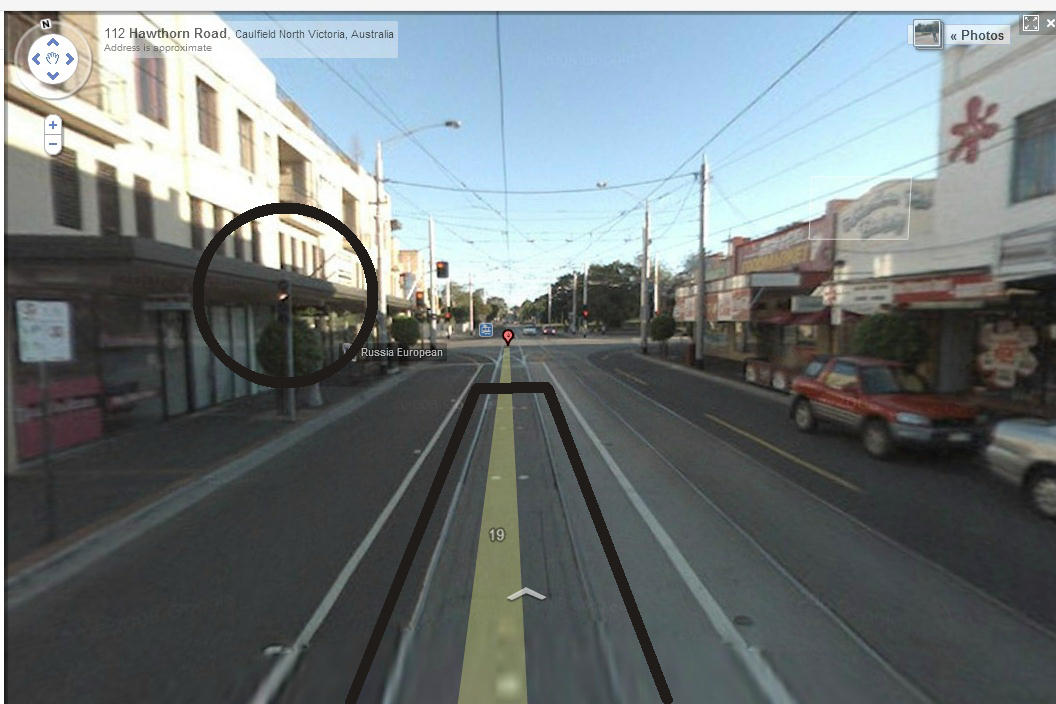
There are 2 basic types of points - The first are Manual, where you see us get out with the giant tuna tin openers (called Point Bars) and click them over. The second are Automatic or Electronic. The system is set up in such a way that if electronic points fail, we can always get out and change them manually. Anyway, check out the picture below:
You should notice (if you squint), there are some white dots on the road inside the oblong. One, two, then three. The circle shows a lantern (or set of traffic lights) that indicates the direction the points are set to. In the case of Kew Junction here, if I was a #109 and wanted to turn up Cotham Rd, I would twist the points switch on the console as I approached the first dot. Between the first and second set of dots, there is a transponder that picks up the signal and switches the tracks. If I was a #48 continuing along High St, I would simply not touch the switch, as the default signal is "straight".

This second picture shows the lantern closer and while I have highlighted the opposite set of points, it does give you some idea of how the direction changes. This next pair of photos is a better set:

This shows the approach to Balaclava Rd from Hawthorn Rd. This is a unique junction in the system (and one of only two on the planet) in that a tram can turn in any direction from every direction. You can see the white dots and the lantern on the left indicating the points are currently set for a right turn. If I wanted to go straight, I would simply approach this without touching the switch, and as I pass over the gap between the first dot and the second set, the points would switch over.
Final photo shows the points are indeed set for the right:
That little lantern on the left in this picture indicates that priority turning lights can be activated at this location, but more on those another time.

I hope this clarifies any questions about trams turning. It's a fairly old technology and does have a habit of breaking down (electrics + outdoors + "wait till it breaks" = problems), but on the most part they are quite reliable. Only once have I had a real fright and that was when the points failed to change. I got out with the point bar to change it manually and just as I slipped it into the hole, BOOM! They flicked over. Usually if they fail, a horizontal bar appears. Oh, and if a tram behind comes up too close before the first one has cleared, the points remain set. I should say "usually" because part of our training is that if something can go wrong, it usually does when you're on your last run.

LEGAL BULLSHIT
YES, I'VE USED GOOGLEMAPS AND USED TWO EXAMPLES OF AUTOMATIC POINTS. THIS DOES NOT MEAN THAT I COME FROM ANY OF THE DEPOTS WHO USE THESE ROUTES. I USED THEM FOR SIMPLICITY AND INTEREST. I HAVE NOT REVEALED ANYTHING BEYOND WHAT ANY DECENT DRIVER WOULD DO IF ASKED BY A PASSENGER. IF YOU'RE TRAWLING THE INTERNET LOOKING FOR EMPLOYEES WHO ARE POTENTIALLY CAUSING DAMAGE TO THE COMPANY OR THE GOVERNMENT, I SUGGEST YOU FIND SOMETHING MORE PRODUCTIVE TO DO.

Thursday, July 14, 2011

First Post.

Hi, this is Melbourne Tram Driver starting up a blog to help answer some of the questions I've seen on Twitter. Unfortunately Twitter lacks the space to cover certain issues completely and it's difficult to explain complex issues in such a limited space. Hence, this blog is born. Before we get to the interesting stuff, there are some issues that I need to deal with first.

In no way is this blog or my tweets supported or endorsed by Yarra Trams. My goal here is to fill the numerous gaps between what goes on in the real world vs what goes on in tramland. I will share my frustrations with both the travelling public and the running of the system. I don't always tow the company line and, as in the past, I have often suggested people lodge complaints with either Yarra Trams or the PT Ombudsman.

In the end, I'd ask that everyone bear in mind a couple of things:
1. Staff are human and, like passengers, we make mistakes and aren't perfect. When I'm wrong, I apologise right away. Tram drivers have a difficult task. Those vehicles start at 19 tonnes and don't have steering wheels. It can be very stressful dealing with pedestrians/cars who don't know or care about this, not to mention exhausting.
2. We know that most of you pay for tickets and there's a reasonable expectation that a service be provided. If things go wrong, you should be informed (hello? anyone at @yarratrams?). However, please also bear in mind that the service provided suffers from everything the public and government throws at it. It's far from a champagne service. If you need a comparison, take the daily fare to the taxi rank and see what happens.
3. We can't see everything on board or outside the tram. If something's happening, for the love of God, come up and tell us. In addition, we don't know everything. A little bit of homework prior to travelling goes a long way, even if it's just a nearby main road or landmark.
4. Complaints are sometimes warranted and I've sent in my fair share. However, make sure they're targeted at the right people and contain accurate information. If you missed the last tram last night because it didn't run, staff at the Herald Sun comments section won't care or be able to do anything, so don't waste more of your time. Please don't expect me to gather all the problems of the tram system and email them to my boss. There are people whose job is to sort this out and they are the ones that can act on it.
5. In the end, I'm here to help out, as are the vast majority of employees. I enjoy helping people and a quiet, smooth day is what I love as well. If I hated people, I wouldn't be putting myself in a job where I see thousands of them every day. If you want to pick a fight with the driver for whatever reason, save your breath or don't endanger your safety or those of other passengers. Take down details, get yourself home and submit a complaint. And yes, they do get followed up.
6. Don't be afraid to ask questions about how and why stuff happens!

I'll try to post as often a I can, but please don't expect specific information about which lines I work, when I work or who I am. There are many people in this industry who would sacrifice aging parents for a cup of coffee, and I'm not about to put my hand up for that. They're usually the same ones who are shit drivers.

My next post will be about short shunts, something which often causes plenty of grief on the road, but nobody quite understands why.